Facebook Employment Ads Targeting: The Special Ad Category Rules Explained (2026)

In reality, Facebook is not just a platform for selling or finding new customers. If utilized correctly, it is also a “machine” that generates a proactive candidate source, consistently and stably, which can even completely replace traditional recruitment websites for many businesses.
We understand this not based on theory. This year alone, we have directly implemented and managed recruitment campaigns with a budget of over 50,000 USD for a client. We also spent tens of thousands of other dollars on hiding ad management personnel for various projects for our clients. From those practical experiences, in this article, BHW Agency will share with you the correct understanding of Facebook’s special ad categories and how to leverage this platform to build effective and sustainable recruitment ad campaigns for your business.
4 types of Special Ad Categories on Facebook 2026
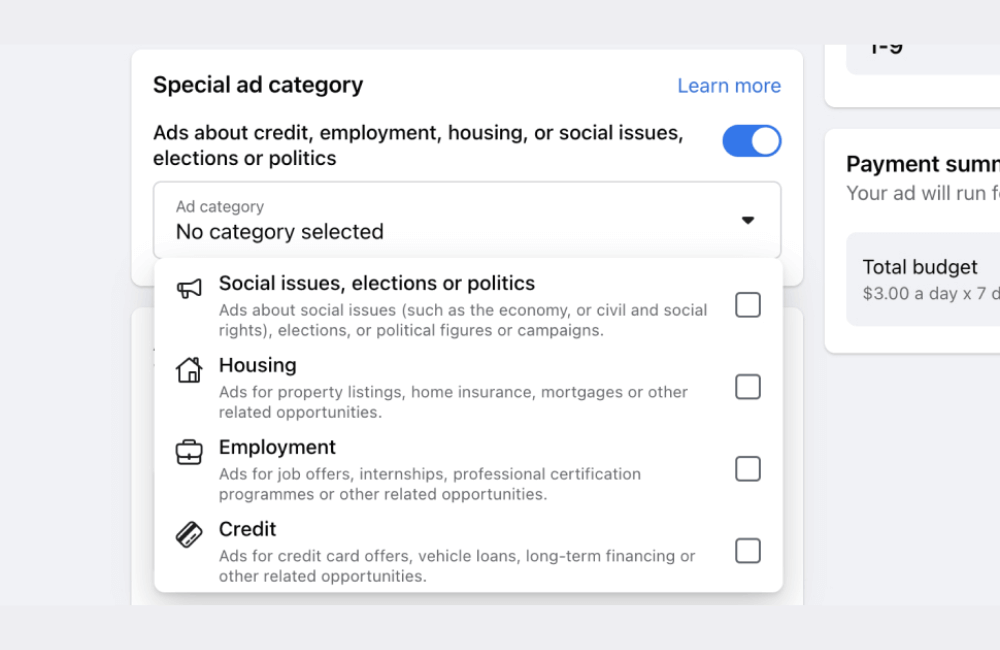
In a Facebook ad account, there are currently 4 Special Ad Categories that advertisers must declare if the ad content is related. Specifically, these include:
- Financial products and services
- Employment
- Housing
- Social issues, elections or politics
Whenever we run campaigns with related content to one of the four groups above, Facebook requires a clear classification from the start. This means you need to proactively tell Facebook which category your ad belongs to, instead of letting the algorithm “guess” on its own. A very practical example:
- If you are running recruitment ads, job opportunities, sales hiring, marketing hiring, or other similar job postings, you must select the relevant Employment Category.
- If you promote credit cards, loans, banking, or investments, you need to select Financial products and services.
- If you are a real estate broker selling houses or renting apartments, you must select a Housing option.
- If the ad relates to politics, elections, or sensitive social issues, you need to select the corresponding category.
If the correct category is not selected and the ads are still running, usually after only 1–2 days, the ads will face delivery restrictions. More dangerously, your ad account may be flagged for serious violations, leading to long-term restrictions or a permanent ban. Therefore, our experience is: whichever category the business belongs to, you must declare the correct category from the start, and absolutely do not “bypass” or skip it.
Disadvantages of running Special Ad Categories
When you select special ad categories, Facebook will activate a stricter control mechanism, especially in the Detailed Targeting section. Specifically, many previous interest targeting options will no longer be available. For example, if you were used to running ads based on interests such as:
- Fitness trainers
- Health and fitness
- Interests related to profession, income, and education
Then, when choosing special categories, most of these interests will be completely removed by Facebook. This is the biggest disadvantage that makes many advertisers feel frustrated when first approaching Special Ad Categories.
Benefits provided by Special Ad Categories
The important thing we want you to understand is: being restricted in targeting does not mean no results. When you classify ads into the correct category, Facebook will use the available reference audience groups within its algorithm. For example:
- With the Employment category, Facebook already has data on groups of people who are usually interested in jobs, seeking career opportunities, or interacting with recruitment content.
- With the Financial category, the system will distribute ads to people whose behavior matches financial services, even if you do not directly target them by interest.
The reason Facebook is so strict is that in the past, these categories were heavily abused, from fraudulent advertising and fake income promises to discrimination. Therefore, Meta is forced to implement strict controls to protect users.
Guide to targeting Employment Ads on Facebook
Running recruitment ads on Facebook is inherently not much different from running sales ads or lead generation. However, the key point lies in how we set up the campaign, the mindset regarding candidate audiences, and how to comply with Meta’s policies. In this section, we will share in detail how advertisers can build and optimize effective recruitment campaigns, based on practical experience with various projects ranging from small to tens of thousands of USD in budget.
Employment campaign Structure on Facebook
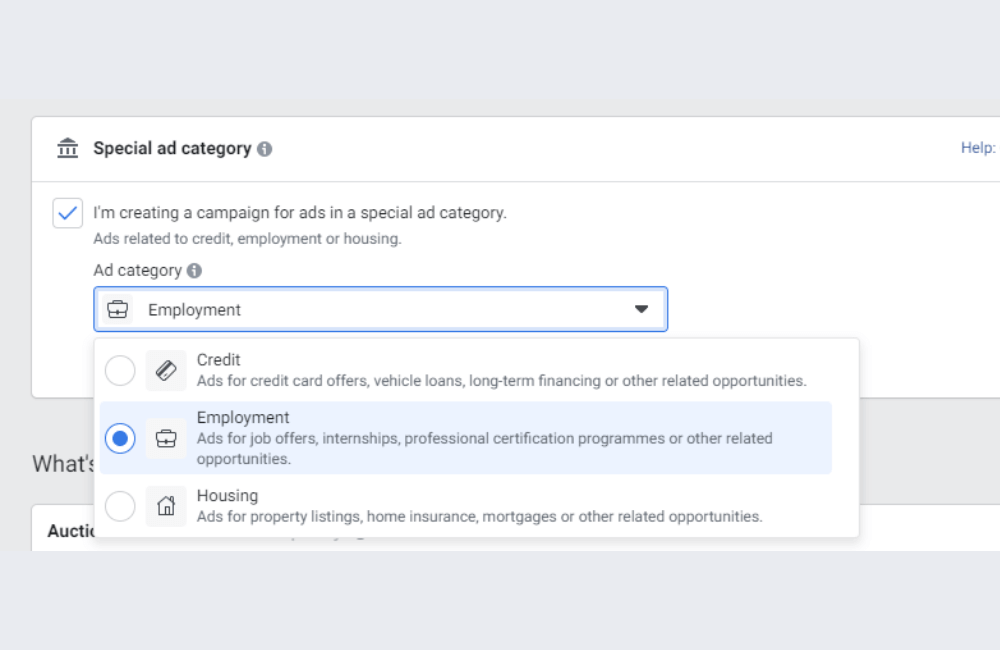
The way we build recruitment campaigns is almost identical to the standard lead generation campaign structure, differing only at one extremely important point at the campaign level. When creating a campaign in Ads Manager and scrolling down to the settings, we always enable Special Ad Category and select the Employment category. This means you are proactively informing Facebook that your ads are related to recruitment and career opportunities.
Enabling this category is not optional, but a mandatory requirement by Meta to limit discriminatory practices in recruitment, such as gender, age, racial discrimination, or other sensitive factors. If you intentionally do not enable it and still run recruitment ads, your account is highly likely to be restricted or blocked.
Note: If you use Instant Forms to collect candidate applications, you need to be extremely careful with the questions. Questions related to gender, marital status, age, or sensitive personal factors can easily cause the ad to be rejected. Personally, we often do not use Instant Forms but instead direct candidates to a separate landing page to better control the experience and data.
Correct Mindset when running Employment Ads
Recruitment advertising is essentially the same as sales advertising. Instead of an ideal customer profile, you need to build an Ideal Hire Profile. Candidates also have different desires, problems, and levels of awareness. Some people have not realized they are being underpaid, some are bored with their current job, and others are actively looking for new opportunities.
For example, with the unaware group, you can run ads comparing market salary rates. For the high-awareness group, the ad only needs a clear CTA like “We are hiring copywriters, apply today.”
In campaigns where the market is familiar, and recruitment demand is high, we often run very direct ads, focusing heavily on the CTA. Conversely, for large-budget campaigns for corporate clients, the ad content is usually more invested, using well-produced videos that tell stories about the work environment, career path, and professional opportunities. Candidates are then directed to a recruitment landing page, which features a video explaining the role in detail, reasons to work for the company, and a clear application process. This can be considered a type of VSL, but the product here is the job.
Effective Employment Audience Targeting Methods
At the ad set level, we focus primarily on geographic factors and language. You can target by city level, region, or a radius around the business location. In a recruitment campaign in Canada, we targeted specific provinces combined with language factors, as the client only wanted to recruit French-speaking candidates. Aside from these factors, most other options are left completely open.
Placements are always set to automatic so that Facebook distributes ads to positions that bring the best efficiency. For local businesses such as plumbers, restaurants, or technical services, you can choose a specific city, set a radius, or drop a pin directly on the map. This method works very well when you only want to recruit staff within a narrow scope.
How to allocate the budget
With a small budget, we usually put all ads in one ad set so that Facebook has enough data to optimize. When the budget is larger, for example, recruitment campaigns that have spent over 50,000 USD, each ad set usually contains only a single ad for easy performance tracking. The important thing is not to overcomplicate the structure. Recruitment ads need to be clear, direct, and focused on the job invitation, rather than testing too many unnecessary variations.
Pixel tracking, KPI, and Creatives optimization for Employment Campaigns
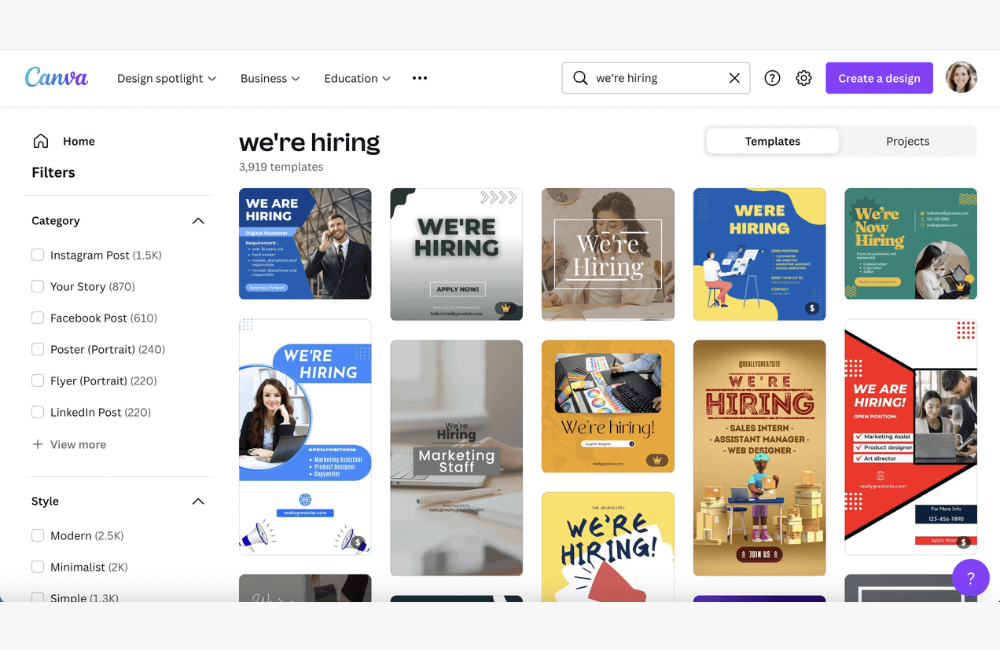
For employment ads to operate effectively, you need to install a pixel, track data, and design engaging creatives using software like Canva,… An important rule that we always apply is that the recruitment cost should not exceed 20% of the annual salary of the personnel.
For example, if a position has an annual salary of 100,000 USD, a reasonable recruitment budget would be around 15,000 to 20,000 USD. From there, you can calculate backward the cost per application and per interview. If the cost exceeds the allowed threshold, you need to quickly turn off ineffective ads and keep the good ads.
Important note
All the above strategies are only truly effective if your business has a good employee retention rate. If you finish recruiting but employees quit after 2 to 3 months, the entire advertising cost will be wasted. Therefore, consider recruitment as a long-term investment for business growth, not just a short-term expense.
Facebook employment ads have their own rules, especially the mandatory requirement for Special ad categories. When you correctly understand how to set up campaigns, have the right mindset about candidate personas, and optimize based on real data, Facebook can completely become a stable, proactive, and cost-effective recruitment channel for businesses. View recruitment as a long-term investment and do it right from the start to attract and retain quality personnel.
Frequently asked questions
Yes. All ads related to employment, recruitment, or career opportunities are mandatory to enable the special ad category to comply with Meta’s anti-discrimination policies.
Yes. In fact, broad targeting combined with ad content that matches candidate insights and a clear CTA still brings in quality applications, and is even more stable than overly detailed targeting.
💬 Contact now for free consultation from BHW!
- Website: https://vi.blackhatworld.io/
- Telegram: @bhw_agency
- Whatsapp: +84819001811
- Wechat: bhwagency
- Email: [email protected]
This article is also available in other languages: