Meta Video Ad Specs: The Ultimate 2026 Guide for All Placements

The more placements a creative can appear on, the more data it collects, leading to better ad performance. Therefore, the key to designing creatives for Facebook Ads is not creating numerous versions, but designing from the outset to fit the crop zones across various placements. This approach helps you reduce the number of variations while ensuring the creative displays well in multiple locations.
Many people are doing the opposite by creating an original creative, then making a square version for the feed and a separate version for Stories, then assigning each version to different placements within the same ad. This is not the optimal method because Facebook requires specific video dimensions for each placement, so each creative will generate a different Post ID. This prevents placements from sharing machine learning data with each other. Essentially, you are running multiple separate ads, each learning from its own dataset. As a result, machine learning is not accumulated on the same creative, slowing down the optimization process.
In this article, BlackHatWorld will share the standard aspect ratios for Facebook ad creatives, along with all the critical crop zones for both videos and images. This will help you create creatives that display effectively across multiple placements without cutting off important content or annoying viewers.
Meta Video Ad Specs: The Ultimate 2026 Guide for All Placements
In the context of Meta increasingly prioritizing video content, especially on mobile devices, understanding ad video specifications is a vital factor for advertisers. We have noticed that many of you invest in high-quality content, yet the effectiveness remains low simply because the videos are cropped, have messages obscured, or display sub-optimally across different placements. Therefore, in this section, we will delve into the most optimal Meta ad video dimensions for 2026 and how to arrange content for safety and efficiency on all placement.
Square video 1080 x 1080 is no longer prioritized
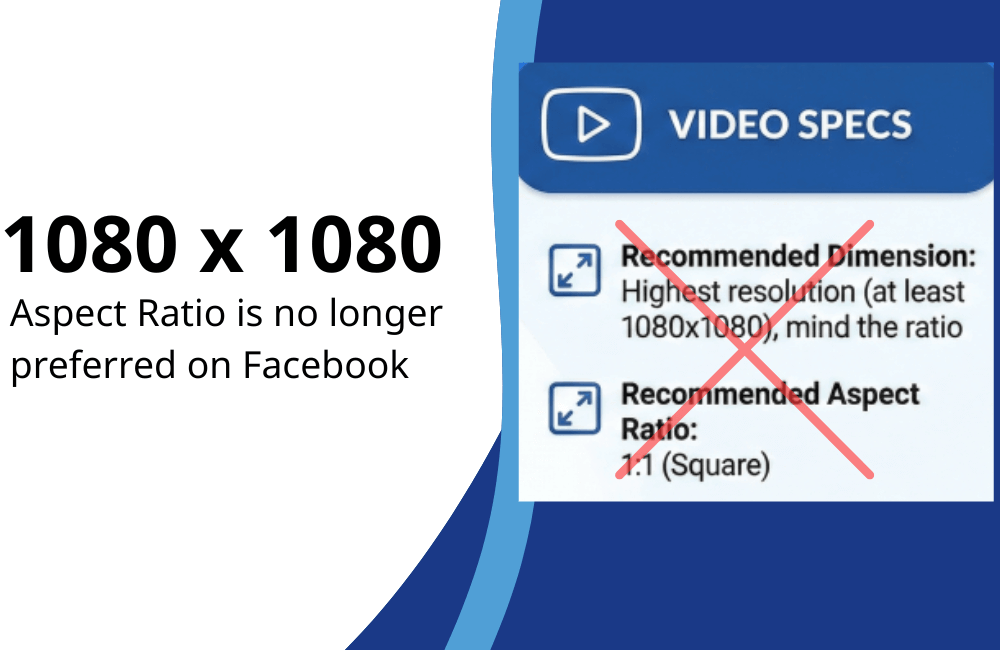
Square video 1080 x 1080 used to be a popular format for many years, but we currently no longer recommend using it extensively. The reason is that square videos occupy less space on the feed, particularly on mobile devices, making the viewing experience less engaging compared to vertical videos. Additionally, square videos still have approximately 170 pixels of danger zones where Meta may overlay interface elements. Meanwhile, overall performance is often lower than that of vertical videos, especially when running conversion or engagement objectives.
The most optimal video dimension is currently 1080 x 1920
With our experience in implementing advertisements for various industries, we strongly recommend the vertical video format of 1080 x 1920 pixels with a 9:16 ratio. This is the type of video creative currently delivering the best performance because it occupies nearly the entire phone screen of the viewer.
The majority of Facebook and Instagram users currently browse the feed, watch Stories, or Reels using their phones. When a video displays in full screen, your message will be more prominent, the video completion rate will be higher, and the interaction capability will also increase significantly. For that reason, vertical creative is the optimal choice if you want to maximize advertising effectiveness.
Safe zones when applying the 1080 x 1920 dimension
However, to ensure that a 1080 x 1920 video displays effectively across all placements, such as Feed, Stories, Reels, or In-stream, we must pay special attention to areas at risk of being cropped or covered by the user interface.
With a 1080 x 1920 vertical video, Meta may crop approximately 285 pixels of height from both the top and bottom in certain placements. This means if you place important content near the top or bottom edges, viewers will likely not see it in its entirety.
We recommend that you do not place essential text, prices, offers, or key information in these two areas. In particular, do not position a character’s eyes, a model’s face, or the main product in these high-risk cropping zones. For example, if you run a cosmetic advertisement where the model’s eyes are cropped out, it will feel unprofessional and reduce the credibility of the ad. All vital content should be kept within the central safe zone. Secondary details such as hair, background, or decorations can be cropped without affecting the core message you wish to convey.
Note on the danger zone below the 1080 x 1920 video
In addition to the 285 pixels that may be cropped at the bottom, there are an extra 315 pixels in height known as the danger zone. This area is not cropped, but Meta often overlays interface elements such as logos, Like, Comment, and Share buttons, or CTA buttons floating onto the screen.
In actual implementation, we have encountered many cases where videos were beautifully designed, but the call-to-action text was covered by the CTA button, making it difficult for viewers to understand the message. Therefore, you should not place important text or captions in this area. While it may be acceptable if the product or background image is slightly obscured, text can easily disrupt the layout and reduce advertising effectiveness. In total, approximately the bottom 600 pixels of a vertical video is an area where we should not place the most important content.
Because of these factors, the 1080 x 1920 format is still considered optimal by us when you know how to arrange content according to standard guidelines.
Alternative 1350 x 1080 video option for Feed
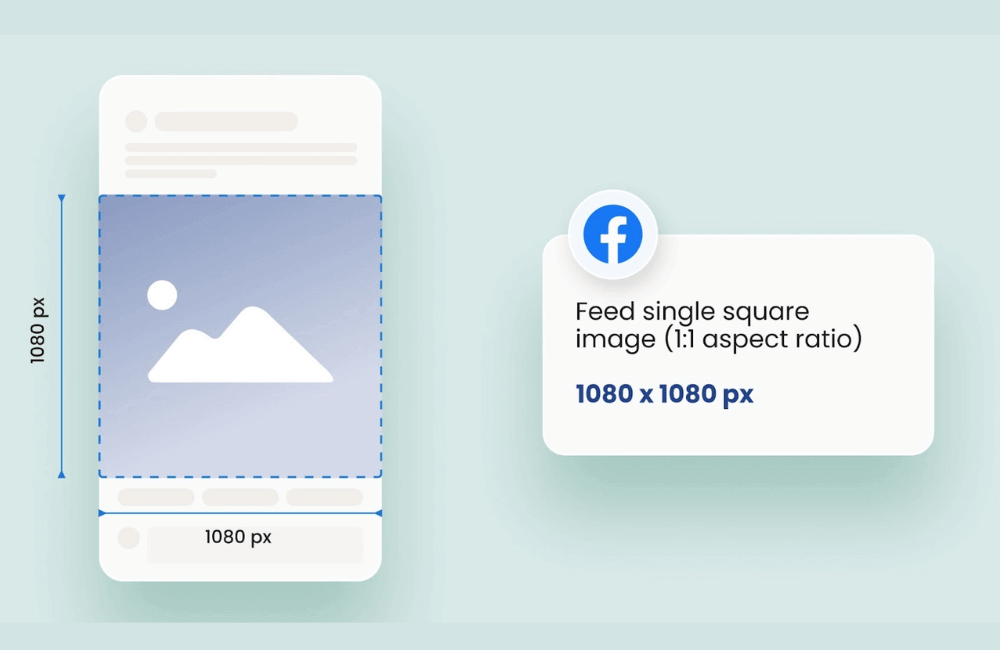
In some cases, if you focus heavily on the Facebook or Instagram Feed, a video size of 1350 x 1080 in a slight vertical ratio is also a good option. This format is not cropped when displayed on placements and ensures that the content is fully visible. However, Meta may still insert CTAs, logos, or icons at the bottom of the video, so the danger zone still exists. When designing, you still need to keep text and important messages in the center area to ensure safety.
Mindset changes when make Facebook Ad Creatives 2026
Creative sizes on Facebook are important for the CTR of a campaign, but many people teach how to set campaigns, set budgets, and choose objectives while ignoring the most core part: creative thinking based on user psychology. This is also the mental framework that we have applied to scale hundreds of DTOC brands with advertising budgets of hundreds of millions of dollars, and in this section, we will share it systematically so that you can apply it immediately.
Meta ads change platforms, but human psychology does not
Before writing any hook scripts or developing visual ideas, we always remind advertisers of one thing: Meta ads are ultimately just advertisements, and advertising always operates based on human psychology. These principles have existed since the era of print ads and outdoor billboards to the Mad Men era, and by 2026, they still retain their full value.
An effective Facebook advertisement always requires three core elements. First is attention, meaning you must stop the user’s mindless scrolling within the first few seconds. Second is curiosity, making them want to stay and watch more instead of scrolling past. And finally, emotion; the ad needs to make the viewer feel something, whether it is empathy, joy, worry, or even frustration. Truly effective Meta ads are those that connect all three elements and create a sense of authenticity with potential customers. By doing this, you are already ahead of the majority of other advertisers on Facebook.
Ideas do not come from a blank page but from research
A common mistake we often see in advertisers is trying to sit in front of a blank Google Docs file and forcing themselves to come up with ideas. In reality, ideas rarely appear that way. We have written thousands of advertising scripts and can confirm that creativity does not come from waiting for inspiration, but from intentional research.
To have good ideas, you need to deeply understand the brand and product you are advertising. If you are a brand owner, you may already understand your product well. But the more important question is whether you truly understand your customers. What customers think, what they say, what they worry about, and in what situations they use the product; that is the key to unlocking effective advertising angles.
Research customers exactly where they actually appear
We often tell advertisers to “fish where the fish are.” To understand customers, you need to go to the exact places they frequently visit and share their views most naturally. One extremely valuable research source is Reddit. This is a place where users feel comfortable sharing both praise and criticism. In many cases, we have screenshotted an entire Reddit thread and used it directly as a static ad because the content was so authentic and persuasive.

The next source is product reviews. When someone leaves a review, they are usually either very in love with the product or very disappointed. Both provide extremely valuable information. You should read reviews on your own website, Amazon, Trustpilot, or other sales platforms to understand clearly why customers buy or do not buy. During the reading process, look for repeating behavioral patterns. For example, if many customers say they use the product during pregnancy, while you had never targeted this group before, that is a new advertising angle. We often aggregate all reviews and put them into ChatGPT to analyze and discover many product uses that even the brand had never thought of.
Ad comments and competitors are a gold mine of ideas
If your brand is spending a large budget, your ads will certainly receive many comments. The reality is that you have already paid for those interactions. Therefore, do not ignore them. Ad comments are like free focus groups where customers share real experiences, tag friends, and speak in their own language. We regularly read comments to learn how customers express themselves, use words, and react to advertising messages. This helps subsequent ads become much more relatable and natural.
In addition, competitor advertisements are also a good reference source. Meta Ad Library allows you to see which ads your competitors are running. However, we always emphasize taking inspiration rather than copying. If your ads look identical to your competitors’, you will not be able to stand out. Observe other industries and different formats, then adapt them to fit your own products.
Combining AI into the 2026 Ad Creative Process
By 2026, AI is no longer be an option but a mandatory part of the creative process. Tools such as ChatGPT, Claude, or Gemini can all support research, data analysis, and idea suggestions. Personally, we use ChatGPT quite often due to its deep research capabilities and easy integration into the workflow.
When researching, you should create a separate folder to store data, insights, and ad examples. This helps AI maximize its effectiveness while allowing you to compare customer behavior across different time periods.
Build ideas using Angle, Hook, and Format structure
After completing the research, we move to the stage of ideation and building advertising angles. At Fraggle, we usually think according to the structure of Angle, Hook, and then Format. Angle is the core message of the advertisement, such as a product being tastier, cleaner, or more convenient for a specific target group. Hook is the first 3 seconds to attract attention, which can be a shocking statement, a direct test, or a humorous image. Format is the method of expression, such as UGC, static ads, founder ads, or podcast ads.
Each format will suit a different stage in the funnel. At the top of the funnel, we prioritize UGC, street interviews, or founder ads to introduce the brand. In the middle of the funnel, short educational videos or mashup ads help build desire. At the bottom of the funnel, static ads, offers, and testimonials will drive the purchasing action.
Understanding and correctly applying Meta video ad specifications in 2026 will help you and advertisers optimize visibility, reduce errors during review, and improve campaign performance across all placements. When a video is designed to the correct standard from the start, you not only save editing time but also increase the chances of reaching the right customers and maximizing the advertising budget.
Frequently asked questions
The video can still be distributed; however, it is highly susceptible to being cropped, having its display quality reduced, or experiencing restricted delivery, which directly impacts advertising effectiveness.
Yes, it should be done. Preparing appropriate video versions for Feed, Reels, Stories, or In-stream will help the ads display more optimally and yield better performance compared to using only a single video.
💬 Contact now for free consultation from BHW!
- Website: https://vi.blackhatworld.io/
- Telegram: @bhw_agency
- Whatsapp: +84819001811
- Wechat: bhwagency
- Email: [email protected]
This article is also available in other languages: