The Dropshipping Cost Breakdown: How Much Do Facebook Ads Cost for a Winning Product?
In the dropshipping business, advertising cost is always the deciding factor in whether you truly make a profit. No matter how potential a product is, if the advertising cost exceeds the profit margin, you will almost certainly “burn money” without gaining anything. Especially on Facebook/Meta, where everything is based on bidding and the level of competition among advertisers, understanding “how much each product costs to generate 1 sale” is vital. So, how much Facebook Ads Cost?
In this article, BlackHatWorld will analyze with you the entire cost required to test a product, how Meta charges for ad impressions, the minimum budget level to find a winning product, and finally, the formula to help you predict the necessary cost to turn a potential product into a best-seller. Stay tuned!
The Dropshipping Cost Breakdown
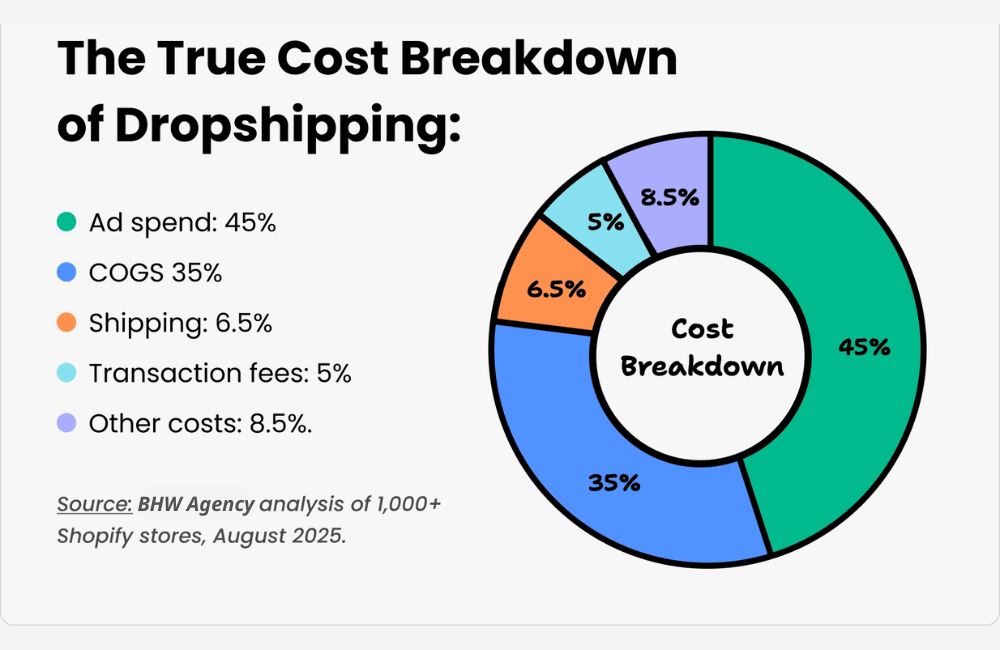
Clearly understanding each expense throughout the process of building and operating the store will help you be more proactive with cash flow, avoid risks, and especially prevent “getting burned” right from the initial stage. Below, we will detail the analysis of every cost that any dropshipper will encounter, accompanied by practical examples for easy visualization.
Platform fees
To sell products, we need a complete store. You can open a shop on TikTok, Amazon, eBay, or Etsy. However, if your goal is to build your own brand and not be reliant on others, we always recommend using Shopify, combined with Facebook ads.
Many of our client use Shopify to create a brand-standard store, then run Meta ads to generate more proactive customer traffic, instead of “waiting for the platform to provide orders.” Shopify currently allows use for the first 3 months for only £1/month. Afterward, the basic package costs about 19–25 USD, depending on the payment method. As for Facebook ad costs, we will analyze that in depth in the section below.
Domain and hosting costs
You can purchase a domain directly from Shopify, but many people prefer using Namecheap or GoDaddy for higher ownership rights. A .com domain costs only about 10–50 USD per year, and you do not need to pay extra hosting fees thanks to the Shopify system.
Website theme costs
There are many beautiful and famous themes available, like Shrine. However, many people use pirated versions, and Shopify may lock the store if detected. We always recommend using the free Dawn theme because it is user-friendly, lightweight, speed-optimized, and suitable for beginners. We also have a 2-hour course guiding a complete store setup using only this theme.
Theme cost: 0 USD.
App Fees
For the store to operate effectively, you need to add support apps. The apps we recommend:
- DSers for order processing
- Judge. me for importing and collecting reviews.
- Klaviyo for sending customer care emails
- Yotpo SMS or SMSBump for sending SMS
- AfterShip for order tracking
- AfterSell for upselling to increase profit
- Booster SEO for SEO optimization
DSers is free, Klaviyo is free up to 250 customers, AfterShip is 11 USD, AfterSell starts from 34.99 USD…
Product Sampling Cost
This is an expense that many people overlook and then pay the price for. Specific example: A customer selling beauty products did not test the goods beforehand. When customers received the product and had an allergic reaction, they faced mass refunds and lost the advertising fee as well. You should test 1–3 samples from each supplier. The cost is around 20–500 USD, depending on the product.
Cost of Goods Sold
COGS only arises after you have an order and typically accounts for 25–40% of the selling price. Example:
- Imported goods 10£, sold for 50£ → COGS 20%
- Imported goods 10£, sold for 20£ → COGS 50%
Cash flow note:
- Shopify pays after 7 days.
- PayPal may hold funds for 6 weeks.
If you do not have working capital, you can easily “die from lack of cash” even when you are selling very well.
Advertising costs
This is the highest cost. We recommend starting from 25 USD per day. For example, in the past I only needed £400 to start making a profit, but now the market is more competitive, so you need to prepare your budget carefully. Not everyone succeeds immediately, but if you know how to optimize ads, you can significantly shorten the time needed to find a winning product.
Other marketing costs
Include:
- Hiring micro-influencers
- UGC production
- Hiring a video editor
- Email marketing
- SMS marketing
Example: One high-quality UGC video costs 100 USD but can generate the first 5,000 USD in revenue if you target the right audience.
Payment processing fees
Inevitable:
- Shopify Payments: 2.4% + 0.30 USD
- PayPal: 3.49% + 0.49 USD
When you sell a product for 100 USD, you will never receive the full 100 USD because of platform fees and currency conversion fees.
Chargeback costs
Chargebacks are a “nightmare” for dropshippers. A real example:
- You sell a product for 30 USD
- The customer files a chargeback.
- You lose 15 USD in processing fees.
- You lose both the product cost and the advertising cost.
Result: you lose nearly 100% of the revenue from that order.
Accounting and auditing costs
Many people underestimate this issue. However, when your business reaches tens of thousands of USD per month, you definitely need an accountant. Auditing costs can be around 2,000 USD per year. You should choose a company specializing in e-commerce to avoid tax problems later.
Business formation costs
Depending on the country, the costs vary. For example:
In the UK, you can start as an individual with almost no cost.
In the us:
- Llc: 50–500USDsd
- Corporation: 40–700USD
- Business registration fees: 75–700USD
- Virtual address rental,PO Box
If you stop operating, you must close the company, and this also incurs additional costs.
How Much Do Facebook Ads Cost for a Winning Product?
When advertisers start analyzing the costs for a best-selling product, the first question is always: “What factors does Facebook use to determine the cost of my dropshipping ads on facebook?” In reality, Facebook’s system does not set prices randomly. It has very clear criteria to evaluate ad quality, and based on that, it determines the advertising cost that we have to pay.

In the example below, we have an account running many different ad sets. In the most recent days, this account has generated a fairly large number of orders. Some ad sets cost more than 100 dollars to generate one order, while other ad sets cost only about 58 dollars. In the report, we set up important columns such as:
- Link clicks
- CTR
- CPC
- Cost per add to cart
- Cost per checkout
- Cost per purchase
However, there are still three “core” metrics that Facebook uses to evaluate ad quality and decide how much you have to pay for each result:
- Quality Ranking
- Engagement Rate Ranking
- Conversion Rate Ranking
When your ads have good rankings in all three of these factors, Facebook will prioritize delivery for you over competitors. This means that you will receive:
- Lower CPM
- Cheaper CPC
- Higher ROAS opportunities
Simply put: high score = lower cost + better results.
Quality Ranking
This is a factor used to evaluate your ads based on user perception and the post-click experience. Facebook not only looks at ad content but also evaluates your website. For example, if users click on your cosmetics ad, but when they land on the website:
- slow loading speed
- poor layout
- blurry images
- no reviews
- or no clear purchase button
Users leave within 2 seconds → Facebook will immediately record:
- high CPM
- high CPC
- low quality
- reduced delivery
This proves that Facebook does not want to show ads that create a poor user experience.
Engagement Rate Ranking
Facebook predicts the likelihood that users will engage with your ads based on:
- clicks
- likes
- comments
- shares
If your ads target the same audience but have lower engagement than the market average → costs will increase. For example, when advertising thermal clothing, video A has a stronger hook and more natural presentation than video B → Video A is more likely to be prioritized by Facebook for delivery.
Conversion Rate Ranking
This is an evaluation of how likely ad viewers are to take conversion actions (add to cart, checkout, purchase). Facebook compares your ads with other ads targeting the same audience to determine:
- Is your conversion rate high or low?
- Do viewers take action immediately or not?
If you have:
- A clear landing page
- Attractive offers
- Persuasive product videos
- Transparent refund policies
Then you will receive a high conversion ranking, which significantly reduces advertising costs.
Optimizing cost per order effectively for Facebook Dropshipping Ads
Before thinking about increasing the budget or scaling campaigns, the most important thing is to optimize in order to reduce Facebook Ads costs for each order. A campaign may have a low CPM, but if the website is weak, the content is not relevant, or the profit margin is low, you will still lose money quickly. Therefore, in this section, we will guide you step by step to optimize everything from the website and ads to the product business model, helping reduce the cost per order to the most optimal level.
Optimize the Website before Optimizing Ads
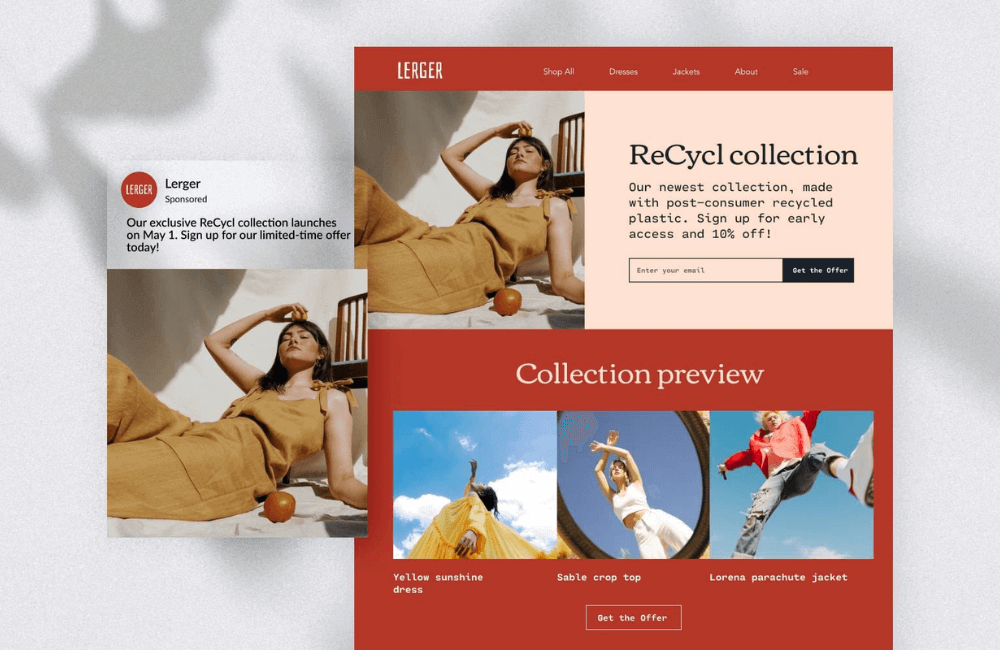
This is always the first step we ask you to do. A poor website is the biggest reason why advertising costs increase, no matter how good the ad creative is. Your website needs to ensure:
- A 100% fit with the advertising message. For example, if the ad says “50% off for a combo of 2 products”, the website must clearly display the same deal.
- Direct access to the product page, instead of sending users to the homepage, and making them feel confused.
- A professional and trustworthy design, such as clear product images, easy-to-read fonts, and a clean layout.
- Fast loading speed, especially on mobile.
- All necessary persuasive elements, such as real reviews, customer photos, return policies, FAQs, and more.
We often recommend that you refer to selected sample websites on commercecream.com, a platform that gathers hundreds of well-designed and well-optimized Shopify websites created by leading agencies, helping you gain more ideas to improve your own store.
Optimize Ad Creatives to increase Engagement and Reduce CPM
Facebook strongly prioritizes ads with high engagement levels. CTR, shares, comments, and likes are signals that make the algorithm believe your ad is “useful”, which leads to wider distribution at a lower cost. One extremely important tip is to create ads that look like organic content, not traditional advertisements. Effective content formats include:
- UGC video: real customers, creators, or natural review clips.
- Humorous memes: for example, a meme like “when you buy product X, and it turns out to be better than expected”.
- Message screenshots: customers praising the product.
- Notes screenshots: reviews written in a personal sharing style.
These formats have clear advantages:
- Much more engaging than heavily produced commercial videos.
- Generate more natural shares.
- Encourage genuine comments.
- Significantly increase CTR.
When engagement is high, Facebook will prioritize delivering your ads and significantly reduce CPM, which in turn lowers CPA.
Optimizing Business Economics
Nhiều bạn chạy ads rất tốt, website cũng ổn, nhưng… vẫn lỗ. Nguyên nhân nằm ở mô hình kinh tế của sản phẩm. Những yếu tố quan trọng gồm:
- profit margin (margin)
- average order value (AOV)
- conversion rate (CVR)
- cost per click (CPC)
- breakeven CPA
- and breakeven ROAS.
We usually use tools similar to a “paid ad scaling calculator” to check all of these metrics before scaling. One example shared by Blake is very thought-provoking.
- A website that was not optimized generated only 39 dollars in profit.
- However, after optimizing AOV, website speed, and conversion rate, profit surged to more than 7,000 dollars with the same level of ad spend.
- ROAS also increased from 1.7 to 3.8.
This proves that whether unit economics are good or bad determines whether you can scale from 100 dollars to 10,000 dollars.
Determining Ads costs for a dropshipping product does not have a fixed number. Everything depends on the market, the level of competition, product quality, ad optimization level, and the performance of your website. When advertisers clearly understand core metrics such as CPM, CPC, CTR, and CPA, and know how to optimize each step, the cost of creating a “winner” product will decrease significantly, while the ability to scale sustainably will increase. The most important thing is to continuously test, track data, and adjust strategies based on user behavior.
Frequently asked questions
Normally, advertisers should test from 30–50 USD per product. However, in highly competitive niches or for high-ticket products, the testing budget may increase to 100–150 USD to collect enough data for decision-making.
The reasons usually come from an unoptimized website, an unattractive offer, an unsuitable product price, or ad creatives that are not convincing enough. A low CPM does not mean you can make sales if the customer experience is poor or the product does not properly solve user needs.
💬 Contact now for free consultation from BHW!
- Website: https://vi.blackhatworld.io/
- Telegram: @bhw_agency
- Whatsapp: +84819001811
- Wechat: bhwagency
- Email: [email protected]
This article is also available in other languages: